
HOW WE WORK
Your first appointment
What happens at your first appointment at Opus
Most people arrive having already been somewhere. They have a scan report they did not understand, a diagnosis that did not fit, or a course of treatment that helped for three weeks. The most common thing we hear is that nobody explained what was actually happening.
So the first appointment is largely about answering that. What is going on, why it started, what will change it, and how long it should take. Everything else follows from getting that right.
WHAT HAPPENS
On the day
An initial appointment runs to around forty five minutes, and most of it is spent on you rather than on paperwork.
- The history, properlyWhat you do, what changed, what you have already tried and what you are actually trying to get back to.
- Examination under loadHow the problem behaves when you move, not only how it feels on a couch.
- Above and belowWe examine the joints either side as a matter of course, because that is where the answer often is.
- An explanation you can repeatIf you cannot explain it to someone else afterwards, we have not done our job.
- A plan with a timescaleWhat happens this week, what happens over the next month, and when we will review it.
- What to bringShorts or loose clothing, any previous scan reports or images, and a list of what you have already tried.
How we assess
The history does most of the work
What changed in the four to eight weeks before it started explains more musculoskeletal pain than any test. It is why the first part of the appointment is a conversation rather than an examination.
We examine under load
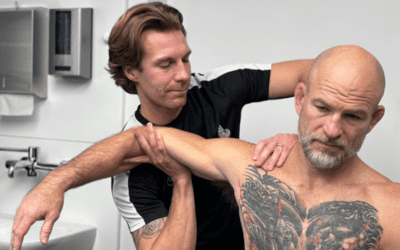
A knee can look normal lying down and fail on a single leg landing. A shoulder can have full range and no strength overhead. Testing what the tissue actually has to do is what separates a diagnosis from a label.
We look above and below
A knee is loaded by the hip and the foot, a shoulder by the neck and the shoulder blade, a back by the hips. Treating the painful part in isolation is the commonest reason problems return, so we examine the whole chain.
Imaging only when it will change the plan
Scans show change that is present in large numbers of people with no symptoms at all. We arrange imaging when the result would alter what we do, not to confirm what an examination has already established, and we explain what a report actually means.
You get the explanation, not just the plan
People who understand their problem do more, avoid less and recover better. That is one of the better established findings in musculoskeletal medicine, and it is why we spend time on it rather than moving straight to treatment.
What you leave with
An explanation of what is happening in language you can use, a plan with a timescale attached rather than an open ended course of appointments, and a clear answer to what you can safely do this week. Where a scan, a blood test or another clinician is needed, that is arranged rather than suggested.
If we do not think we are the right people, we will say so and point you somewhere better. That happens rarely and it is worth knowing that it happens at all.
01
Assessment and examination
02
Explanation of what is happening
03
A plan with a timescale
04
Review and progression
Where to start
If you are not sure which appointment you need, book the first one and we will direct you. These are the usual starting points.
Sports medicine
The right starting point where the diagnosis is unclear, where imaging or blood tests may be needed, or where an injection or medical opinion is likely to be part of the answer.
Physiotherapy
The right starting point for most musculoskeletal problems where the diagnosis is reasonably clear and the work is loading, movement and strength.
Health screening
Where the question is broader than one painful area, covering bloods, cardiovascular risk and the things that are considerably cheaper to find early.
Who you will see
Ten clinicians work at Opus across sport and exercise medicine, physiotherapy, podiatry, osteopathy, endocrinology, performance psychology and strength and conditioning. Which of them you see depends on what you arrive with, and it is common for more than one to be involved.
The clinic is at Emmanuel Kaye House, 37 Devonshire Street, London W1G 6QA. If you are unsure what to book, call us on +44 20 8609 7843 and we will work it out with you rather than leaving you to guess from a list.
QUESTIONS WE ARE ASKED
Before you come, answered
Do I need a referral?
Not to see us. You can book directly. If you intend to claim on private medical insurance, most insurers do require a GP referral before they will authorise treatment, so it is worth checking with them first.
How long is the first appointment?
Around forty five minutes for an initial consultation. That is deliberately longer than the fifteen minutes people are used to, because the history and the explanation are where most of the value is.
Should I get a scan before I come?
No. Bring any you already have, and do not arrange one specially. We would rather examine you first and then decide whether imaging will change anything, because a scan without a clinical picture creates more confusion than it resolves.
What should I wear?
Something you can move and be examined in. Shorts for anything from the hip down, and a vest or loose top for a shoulder or neck problem. If you have come from work, we have space to change.
Can I use my insurance?
Opus is recognised by Aetna, Allianz Worldwide Care, Cigna, Healix Health Services and WPA. Bupa cover varies by clinician, and Dr David Porter is recognised by Bupa Global rather than by Bupa’s UK schemes, so if you hold domestic Bupa cover please check with us before booking with him. Whichever insurer you are with, check your policy for excess and authorisation, and bring your membership and authorisation numbers.
What if I need to change or cancel?
Please give us at least 48 hours’ notice. Appointments cancelled within 48 hours, or missed, are charged in full.
Call the team on +44 (0)20 8609 7843 or email info@opusbiological.com and we will move you to another time.
What if I need someone you do not have?
We will arrange it. Where surgery, imaging or a specialty outside the clinic is the right next step, that is organised for you rather than left as a suggestion at the end of an appointment.
Related articles
Why Rehabilitation Should Focus on Long-Term Health Management, Not Quick Fixes
Rehabilitation should build long-term resilience, not just resolve short-term pain.

Role of Physiotherapy in Fibromyalgia
Fibromyalgia (FM) is a chronic condition which causes pain throughout the body. Other symptoms include fatigue, poor...

Calcific Tendinitis of the Rotator Cuff (CTRC)
Calcific tendinitis of the rotator cuff (CTRC) is the accumulation of calcium phosphate within a tendon and is often...
WHO TREATS THIS
The specialists for this
Sport and exercise medicine
Sports medicine
Sports medicine
Lead physiotherapist
Physiotherapy
Podiatry
Osteopathy
Consultant endocrinologist
Performance psychology
Strength and conditioning
Book an appointment
Our specialists are here to help. Book your appointment and take the first step towards better health.